Showing posts with label intern. Show all posts

Tuesday, May 26, 2009

Basket Making Workshop with Pamunkey Tribe, last Saturday

Last week I spent a good part of my time working on researching Pamunkey and Potomac related basket making techniques.

I went to the Rockefeller Library, which is part of the CW Foundation, and pulled books on Appalachian basket making. The techniques used by Appalachian basket makers are very similar to those of the Pamunkey, and other Virginia Indian groups. They use white oak, which ends in a beautiful, smooth, and natural basket, and durable too.

I spent quite sometime reading about basket making and the history of, including the influence of Indian basketry on Appalachian techniques. Buck chose sections from some of the books to include in a packet we were putting together to distribute to those who attended the class. This included a how-to portion featured in the book Appalachian White Oak Basketmaking, Handing Down the Basket by Rachel Nash Law and Cynthia W. Taylor.

We then copied some photographs from the book Basketry of Appalachian Mountains by Sue H. Stephenson. The images we pulled shows some of the similar technique that we read about in "Indian Notes and Monographs" which was a series of publications discussing Native Americans and First Nations people published int he early 1900s (1915-1925, etc) by the Heye Foundation (which was the original foundation for the National Museum of the American Indian). Anthropologist Frank Speck spent time exploring and living with Native Virginian Indians and wrote an article about the Rappahannock Indians, a tribe that traditionally fell under Powhatan's rule in the 16th century etc. Many of these related Virginian tribal communities have some similar craft styles, so we were able to take the small group of information featured in his document and include that into the packet. This document also featured some images of Pamunkey/Rappahannock basket makers.

Speck featured images, and most importantly some documentation in regards to a special type of rim weaving that is only see in Virginia Indian basketry, something even more specific among Pamunkey weavers.

We also took another article by Speck from another one of the "Notes and Monographs" series, discussing the Powhatan Tribes, which featured information on Pamunkey basketry.

I did some research through various museum websites in regards to baskets in collections. I emailed Crista Pack at the Eiteljorg as to any related basketry that they might have, but nothing was really related to what I was seeking. I did, however, find some baskets on the NMAI website that related to what we were looking for:


This basket was collected by Frank Speck back in the 10s/20s, and came from Potomac Creek, Stafford Co. Virginia. He says that it was made by the "Potomac Bank of Powatans" and that it is a large carrying basket of white oak splints. I'm not too savvy with explaining the aspects of basketry, but, the rim of the basket features a technique with those extra pieces of oak going down to hold the rim down, does that make sense? I'm not sure if it does..but, I'm not a basket expert.

We were also trying to learn more about fish/eel trap baskets that were made in the region. Here is an example, made by Gordon Bullock (c. 1925), which is from Stafford Co., VA, and is also made of white oak splints, from the Potomac community.


This is also in the collection at the NMAI.

We also included directions on basketmaking, provided by our basket making artisans here at CW, and a few things from the books mentioned above.

Buck then took all this information, some of the books, etc, and visited the Pamunkey Reservation last weekend, Saturday, and they hosted a workshop on traditional basket making. I was unable to attend, but Buck said it went well, with a great turnout and a lot of inspiration.

Here are some photos, compliments of Buck Woodard of the American Indian Initiative program here at Colonial Williamsburg:

All these pictures were taking at the Pamunkey Reservation:


Splitting the log, etc, from the white oak trees.

And then the process begins....


And the final product!!


The American Indian Initiative is working with Native communities, locally and beyond, to bring together community members to work together to instill traditional crafts, techniques, and history. This is just one of the many workshops planned off site from CW, which helps to not only reintroduce or work to perfect traditions within communities, but also helps to build a better rapport, relationship and strength between CW's Indian programming and Native communities near and far.

Friday, May 8, 2009

Sweet! We made Indian Country!

We're quite giddy here today, because on May 6th (we're a little late...yes) our Cherokee Delegation press release went out and made it in Indian Country! This is basically the New York Times of the Indian world. 

You can read the article about the Cherokee delegation coming to camp for the weekend...here!

Yorktown National Battlefield

I was able to take sometime in the past week to do an incomplete visit to Yorktown National Battlefield, the final battle which won the Americans their independence from the British with help of the French. 

The entrance to the park.

The nice thing about the historic triangle (they call this, Williamsburg, and Jamestown that) is that when you go to both Jamestown and Yorktown you pay $10 and you get to go to both for one week as many times as you want. So I took advantage of the admission paid at Jamestowne to visit here. Again, I hadn't visited here in over 10 years, and I look forward to going back before my stay here is finished. 

The battlefield museum is highly out of date, where it's funny. The displays are okay, but things are dusty, old and not updated in regards to conservation techniques and lighting. I was pretty interested in the African American representation there, in regards to blacks fighting in the battle, and the personal "servant" of George Washington, Billy Lee. If was able to have written this fresh from leaving Yorktown, I'd have more to say. I guess that says things didn't stick with me enough - but an entire exhibit could be made around blacks in the revolutionary war, but, I was glad to see something. They did not discuss anything in regards to Native people fighting there, but I am not sure yet of Native peoples fought at Yorktown. 

So, after exploring the small museum, I took a walk to downtown Yorktown, but wanted to see the battlefields, so I didn't spend much time there. I do hope to go back, because I missed the surrender spot! I did however take a few pictures...

A section of the Yorktown Victory Monument at the town. It was passed by congress to be resurrected as early as 1781, but, ground breaking wasn't until 1876.

A replica American cannon and earthworks. 


The above three pictures are French cannon replicas in the area that the French armed the heaviest, the built all the earthworks within a day and when the English woke up in the morning, they freaked out by how close the French were, and how large the mounds were. 


Most people don't know that Civil War battles also took place on the land in the park. The Yorktown National Cemetery is here, featuring a small but nice plot of land catering to Civil War soldiers. There are a large number of plots dedicated to unknown soldiers, and they are all double buried, quite chilling! 

A Visit to to Historic Jamestowne

Last week Preston and I were able to visit Historic Jamestowne, the original site of the first permanent settlement by the English in America. I love National Parks, something about visiting them gets me way too excited, like a child, and I just want to explore as much as I can. I feel safe at these places, and it's been sometime since I've visited a National Park, and over 10 years since I had been to Jamestowne

First we visited the glass making house, where the archaeological site is wonderfully preserved and reconstructed glass houses are being used to create famous Jamestowne glass. 

The settlement failed with making glass, they made small portions and decided to retire the glass making attempts quickly. We even took a look around at the cool items made at Jamestowne, but, the items were WAY to expensive. Seems they were just as expensive as when my dad went there back in the 70s with my mom - he could only afford a small glass coaster, which was the same for us, but we didn't purchase anything! We did take some pictures, and hung out on the beach for a few minutes. 


Preston and I on the beach near the glass house. Our attempt at a self-couple portrait :)

The beach at Jamestowne near the glass house


The two glass houses, both in use. The two guys, dressed in pseudo peasant period clothes, were smoking cigarettes and drinking soft drinks when we walked up. It took a few more tourists to show up before they started working and talking about their personal lives to each other while acting like we didn't exist. Regardless, they're cool "pods" and the process of glass blowing is really fascinating to watch. 

Next, we walked over to the site of the fort, after briefly exploring the museum, which is fairly updated. I was impressed with the section (albiet small) dedicated to the Native people of Virginia, they discussed their historical importance and their contemporary worlds and contemproary photographs. This section also shows some interesting artifacts that relatives of the Rolfe family claim were Pocahontas (like a pair of really sweet pearl earrings!).

We saw a lot of turtles - swamps surround the fort area. It is a beautiful location, a shame so many people had to die to make it work. 


They have been doing archaeological digs here for over a decade and have been finding impressive things. There is an entire museum on site dedicated to the remains and the archaeological finds. These are the same people seen in "Pocahontas Revealed" exploring the Powhatan village across the James River. It was very windy, and the students and staff weren't there for sometime, then when they came back they covered up and closed down shop. 

The old church at Jamestown, this church is still a holy spot, but, it ceased having a steady congregation after the capital was moved to Williamsburg due to the tough terrain people had to pass to go to it. It's a haunting place, they believe a knight is buried there. 


I'm sure you can guess who that is - yes, Pocahontas. She is right next to the church, and her presence is almost saint-like. The fascination and reverence that people hold towards her is remarkable, and you can see this by how many times her hands have been rubbed. A volunteer told me that community members want her remains brought back to Virginia. I didn't question it.

Graves of settlers who most likely died during the starvation time, a painful time when 80% of the population died at Jamestowne. They have the names of those they believe are buried here, and the crosses don't represent the amount in this presumed mass grave. There is a name on the list that is a surname of P's family, so it's triggered curiosity for us. 

Preston "modeling" (not really...) at one of the reconstructed living spaces in the fort. 

Captain John Smith, the man who started it all. He exaggerates, he makes a ton of money writing overinflated books about his life when he moves back to London, then dies a pathetic man. 

the end. 

Thursday, May 7, 2009

Meherrin Delegation at Colonial Williamsburg 4/28

On the 28th of April we hosted the Meherrin Indians from North Carolina at Colonial Williamsburg. It was a whirlwind day of filming, talking, learning, exploring, and more. 

One of the goals here at CW's American Indian Init. is to use tactics of delegation to involve Native peoples who were historically mentioned in the records and involved at CW in primarily the 1760s up to just after the Revolutionary War. The Meherrin tribe is a small, state recognized group who historically fought alongside various groups (Cherokee, Shawnee) at Williamsburg during the Revolution. The Meherrin who visited were friendly and very willing to share their experiences and opinions about being Native in the Southeast. 

This was my first time working with a community of Native peoples, and it was an overwhelming and powerful day for me. 

Here is a link to their tribal website : http://www.meherrintribe.com/

So, we invited a delegation consisting of Chief Lewis and various (often family members) other community members.  Seven came in all, anxious to learn more about relationship potentials with CW and their historical interactions at Williamsburg.

We started out taking a tour of the costume design center (CDC) at CW. I had yet to go here either, and this was a very rare (they rarely allow tours) chance to explore this impressive and amazing center that creates all the clothing that interpreters and actors wear at CW.  We were given a tour by Tom, the head of the department (I believe it's Tom, I've met so many people lately...).  We saw everything - from dry cleaning to where they loan out the clothing, to the bar codes on each article, to the racks and racks of buttons, lace, ribbon and fabric...the conservation area, etc. 

Tom presented a selection of articles related to Native life at CW and in the 18th century to share with the Meherrin's. We saw pieces that were created for a character that is represented during black history month - a slave woman who is kidnapped by Indians (not sure what tribe), is assimilated into tribal life, is traded back to Williamsburg, returned to her owner, and she remains assimilated as an Indian - wearing traditional clothing, etc of the period (which is heavily European actually).  It was quite exciting! We also got to see the first of many trade shirts which are being created for Native interpreters. Chief Lewis received his, which he would be wearing in filming later in the day. 

After CDC we went to Collections, where the department showed us a pair of 18th century moccasins (similar to what the Meherrin's could have historically worn), and a very rare (one of 6 in the world) slave halters. 

I was able to take some pictures, you'll see those farther down.

After collections we went to PP&V for the filming of a scene featuring Chief Lewis! Chief Lewis donned his newly made trade shirt to be involved in a scene featuring Daniel Boone, being adopted into a Shawnee family. The Chief got to bath, apply paint to and "pluck" Boone. Electronic Fieldtrips are ways for people who can't necessarily make it to CW to learn about history connections at CW and beyond. These are DVDs and internet programs that schools use to educate kids. The highest showings are in California and Oklahoma, making Native history a strong priority in the programs. CW prides itself on bringing Native people in to play Native peoples, and Chief Lewis was quite excited to be in the show!

The EF that he was working on is called "Westward!" and tells the story of Daniel Boone. 

After a very long day, Buck went out to dinner with the Meherrins and Preston and I hooked up for dinner.  

It was a successful day of learning, exploring and educating. It'll be great to see where things go with the Meherrin's

I did get opportunities to speak with members of the community while Chief Lewis was filming, as we sat in the green room. They shared horrible stories of racism. One of the elder members of the group stated that going to school in the 60s in North Carolina - it was horrible, and that her mother had to meet her at the bus stop everyday or she'd come home bloodied and beaten. She went to an all black school - the Native experience in the African American contemporary south, an experience rarely discussed or documented. 

One of the younger Meherrins stated that "It's better to be black then Native in North Carolina, at least blacks have a place there." It was quite an eye opening and powerful statement, I'm still trying to let it sink in.

One of the women spoke of the horrors of having crosses burned on her yards as a child. Another Meherrin spoke of racism, discrimination, and the struggles of being racially profiled by cops. 

It was an eye opening experience, and something I haven't heard much about. It's painful to hear...

Regardless, here are some photographs from our trip to CDC.  Thank you to the Meherrin people for visiting us, letting us take them into our world (my new world!) and thank you for being so open about your life experiences. I look forward to seeing you again in CW and beyond!

A member of the collection team (in white lab coats) shows 18th century Iroquoian moccasins to members of the Meherrin tribe. 


All the objects, especially the moccasins, were well documented by the Meherrin. These photos will be inspiration for regalia making, historical documentation, and also serve as strong connection with their cultural heritage. 


Buck (far left) explains the history of the slave halters. This rare object is one of six (we believe) in museums worldwide. A fragile item used by Iroquoian tribes to transport slaves. 

Monday, April 20, 2009

So for the past few months I have been working on rehousing the Eiteljorg's entire Edward S. Curtis photogravure collection. What is a photogravure you ask? Click on the link to find out.

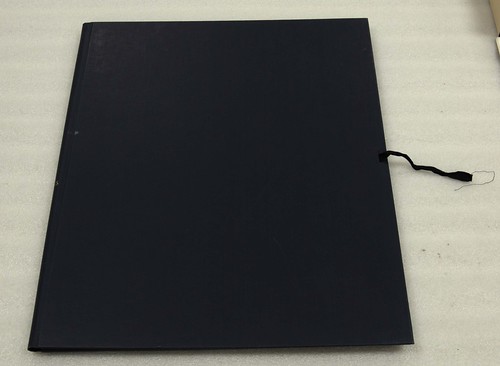
These delicate images were being housed in their original portfolios, as seen here:


These portfolios, with three gate folds, have gold stampings on the side with the number of the image series (i.e. 1-16 or so). Each case holds about 35 images, featuring a table of content with Curtis' original comments on selected photos. These were published in the early 1900's, and most of these were purchased by Harrison Eiteljorg throughout his expansive period of collecting. The museum also owns many multiple copies, and some photographs were purchased to "fill in" for missing photos, which Harrison, or other collectors, acquired over the years.

The portfolios are stored in a stacked shelved unit in a temperature controlled environment, known as The Vault, where all objects are housed unless on display.

I am taking these images out of their original portfolios and rehousing them in archival boxes. Many of the photogravures are also matted from exhibition at the museum, and these will be reorganized to meet organizational standards involving safe storage, preservation, and accessibility.

And, to save time, I have taken these images from the Library of Congress' Edward S. Curtis website, since his images have lost their copyrights. I am downloading these high res images and uploading them into our TMS system, giving proper credit to the LOC. This saves the Eiteljorg time and money from photographing over 700 photogravures. The only images we are photographing are those not listed on the LOC website (less than a handful) and those that show signs of conservation concerns.

So, here are some images of my project, involving the rehousing of the pieces. It is yet to be completed and will be finished in the Fall upon my return to Indianapolis.

Edward Curtis <span class=
The portfolio upon opening. 


Edward Curtis <span class=
The content page with Curtis' text.

Edward Curtis <span class=
Here is a photogravure in its new home, an archival box. Upon finishing a box, I place the content sheet on top, with tissue, and then we leave it up to Amy on what to do with the original portfolios. Sometimes I wonder if they should even be accessioned? Makes me wonder what gets accessioned or not, in regards to accessories to collections? If that makes sense...?

Edward Curtis <span class=
Up close. I don't know the name of this image, sorry!

Edward Curtis <span class=
And here it is, safe and sound.

Eventually I'll have images of the final collection housed. But, you get to anxiously wait until the Fall.

I did get all the images in the computer though, so that's exciting!

Ok, back to my finals!

Museums and the Web 2009

A few weeks ago Amy McKune asked me to represent on her behalf at the Eiteljorg's hosting of a demo for the Museum & the Web Conference 2009. Amy, along with Dr. Larry Zimmerman and Richard McCoy (Objects Conservator at the Indianapolis Museum of Art) worked together with the Purdue computer science department's assistant professor of CS Daniel Aliaga and grad students Alvin Law and Yu Hong Heung, to create a unique conservation technique titled "An Interactive Display for Real-Time Viewing of Virtually Restored Museum Artifacts" Here is a link to the paper, I'd take a look there, for a better explanation of what it consists of, and how it executes itself.

So, Monday, I greeted the Purdue team and helped (alongside with help from Larry & Richard and the staff at the Eiteljorg) them set up their demo for the following day's staff demo and pre-conference demo.

I admit, it was a long process...however, it worked out well, and after plenty of hitches, it eventually went off without any. It did take about 9 hours to set up, but, on Tuesday everything went well and the team was off to the IMA for an equally as long set up, with a new object.

It's an interesting project, and I think could have potential use for public interaction and conservation interaction.

Here are a few images documenting the set up for your viewing pleasure, click on the picture to see my flickr show. Just short and sweet.

First Post

Why hello there! My name is Sarah, and yes, as you see above, I am Your Favorite Museum Intern.

I am a 28 year old "adult learner" who returned a few years ago to college after a stint as a make up artist for a major cosmetics company (if 6 years is a stint). Life happens, and it was time to head in a different direction.

I was surprised to find out that I could get an actual degree in regards to working in museums. I decided to go for it, also getting a degree in General Studies, at Indiana University at Indianapolis. After leaving the cosmetics industry, I took on a job as a gallery director at a fine art gallery in Indy, called the Domont Studio Gallery. I was lucky to have hardcore experience working in a fast paced environment of a for-profit art gallery. From this venue I gained contacts in the public and private sector, and had hands on experience of handling of objects, curating, artist relations, marketing, and more.

This is my final year in school, and I've done quite well for myself in regards to school. I came back in 2006 having to make up a 1.548 GPA from my first "attempt" at school just after high school graduation. I did bad in class, but I got an A+ in partying hard, I can tell you that. I now have a really great GPA, and I won't rub it in. It took a lot of hard work, and I am proud to say I'm a regular on the Dean's List and a "Roads Scholar" no, not a RHODES scholar. This means I get free parking on campus for a good consistent GPA. No Oxford for me, sadly.

Anyway, in the program we have to do a number of internships. I, luckily, had a great contact in Jennifer Complo McNutt, the curator of Contemporary Art at the Eiteljorg Museum. She also is the head of the museums amazing Fellowship program, which brings contemporary Native Americans into the international spotlight by providing money and support, and then an epic show in the Fall of their years work at the museum (and it's by far one of the most groundbreaking and innovative art fellowship programs in the world, and she works her butt off, as does everyone here involved for this program). Jennifer was able to put me in contact with Amy McKune, Director of Museum Collections at the Eiteljorg. Amy weaseled me in to the collections department, and I have been interning here since February.

I work alongside Crista Pack, Conservation Technician, and yes, that is a link to an article in the New York Times that has Crista in it. Yes, New York Times! Anyway, we work together to document, catalog, photograph, stare at and conserve. She does the fancy conservation work, I just take some nice photos, stare at nice photos, and stow away the nice photos.

My main task, which is overseen by Amy and Dr. Larry Zimmerman, my mentor, is rehousing and organizing photogravures by the infamous Edward S. Curtis. We have over 700 Curtis' in our collection, and I have taken on the task of housing them in archival boxes, in an organized fashion, and making sure there are images of each piece in our handy program, The Museum System (this is sort of like a computer library of all the objects a museum has and the info to go with each item). Since the copyright expired on these pieces, instead of photographing almost 800 photos, I am taking them off the Library of Congress website (and yes, giving credit to them in TMS) and taking photographs of items that have conservation issues, or are not on the website (only a few). This allows for curators and collections staff to easily gain access to the images, without having to disrupt the objects by unnecessary handling.

So, on that note, today is actually my last day here. In the Fall I will be coming back to do more work, and finish my project, thanks to the awesome staff here at the museum being so flexible.

Why am I leaving? Well, I decided to apply at two other plays for internships: The National Muesum of the American Indian, at the Smithsonian in D.C. and Colonial Williamsburg in Virginia. To my surprise I got both. So, this week, Friday, I will be leaving Indianapolis to head off to Colonial Williamsburg to work with Buck Woodard of their public history department's American Indian Initiative. Here we will be working with Native communities to incorporate their historical and contemporary stories into CW and Virginia public history programs.

Then, I leave for DC and from June 1-August 7 I will be living on George Washington University campus and working at the NMAI's research facility in Maryland doing research work in regards to an upcoming exhibit. This is a dream come true for me!

So, a long story short, here you can learn about my projects, my life as I meld into the museum industry, and struggles and non-struggles. I will be documenting my experiences at historical and cultural venues throughout the Southeast, as well. My work goals focus on Native American and minority representation in public history - and my writings will document that greatly.

Ok, back to work!